
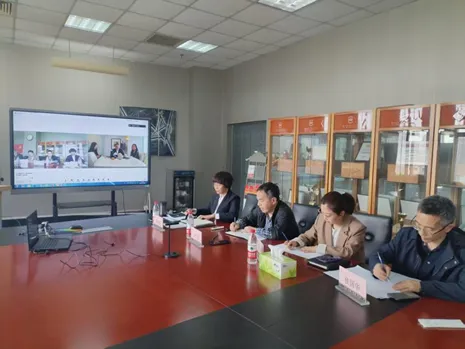
In April 2025, Tianjin University of Commerce’s International Education College hosted an online ESG collaboration forum. Attendees included: Research Director Liu Bin, College Dean Cao Xiaoli, International Office’s Yu Xuejiao, faculty Hou Guohua; and ASEPG’s Executive Dean Mr. Joseph Mak, Program Director Kay Lee, and Marketing Director Lily Yeung.
The forum advanced discussions on ESG and “Dual Carbon” industry-academia-research cooperation, focusing on talent development for China’s sustainability goals.
During the forum, Prof. Liu Bin showcased the university’s distinguished research achievements in cold chain logistics and modern service industries. The institution has made remarkable progress in commercial circulation technologies, earning the prestigious State Science and Technology Progress Award and establishing several national and industry standards. Current research focuses on green technology development including waste-to-energy conversion and frozen food disinfection technologies, with pioneering work in power electronics and biomass reuse to support carbon reduction in Tianjin’s Jinnan District zero-carbon pilot zone.
Dean Cao Xiaoli presented the International Education Cooperation College’s distinctive programs and international talent cultivation initiatives. She proposed establishing a joint ESG Research Center with ASEPG to deepen collaboration through resource integration in ESG-related fields.
ASEPG Executive Dean Mr. Joseph Mak shared the institute’s global development strategy as an international ESG cooperation platform. ASEPG brings together top experts worldwide specializing in green finance, carbon management, and ESG training. Through strategic consulting and carbon solutions, the institute supports corporate ESG transformation while facilitating global best practice exchange. Mr. Mak expressed ASEPG’s interest in collaborating with Tianjin University of Commerce on ESG education programs, talent development, and policy research to advance Tianjin’s ESG ecosystem development.
The productive discussions highlighted concrete opportunities for partnership in research, talent cultivation, and policy development to accelerate sustainable growth.
The symposium successfully initiated collaboration between APESG and the International Education Cooperation College. Both parties will establish an ESG Research Center to jointly promote talent development, scientific research, and social services in sustainability fields, translating discussions into concrete actions.
School of International Education, Tianjin University of Commerce
Established in January 2000, the School of International Education at Tianjin University of Commerce operates seven administrative departments including the Dean’s Office, International Student Admissions Office, Inbound Affairs Section, Academic Affairs Office, Student Accommodation Office, Student Affairs Office, and Confucius Institute Office. Academically, it consists of three teaching units: the Preparatory Education Department, International Chinese Language Education Department, and Chinese Language Training Department.
Guided by the principle of “Building on the Present, Focusing on the Future, Strengthening Distinctiveness, and Developing Competitive Advantages,” the School is committed to international exchange and cooperation. It integrates high-quality educational resources by adopting advanced international teaching methodologies, curriculum systems, and management approaches. Through continuous educational innovation, the School cultivates globally competent talents with international perspectives and creative thinking.
With over two decades of experience in international Chinese education, the School welcomes numerous long-term and short-term students annually from the United States, South Korea, Japan, Thailand, and other Southeast Asian countries. It offers a Chinese Language Bachelor’s program, 54 undergraduate majors across seven disciplines (management, economics, engineering, law, liberal arts, sciences, and arts) for students with HSK Level 5 or above, and 68 postgraduate programs for students with HSK Level 6 or above.
The School has developed a distinctive educational system that promotes comprehensive student development while maintaining balanced growth in scale, structure, quality, and efficiency.