
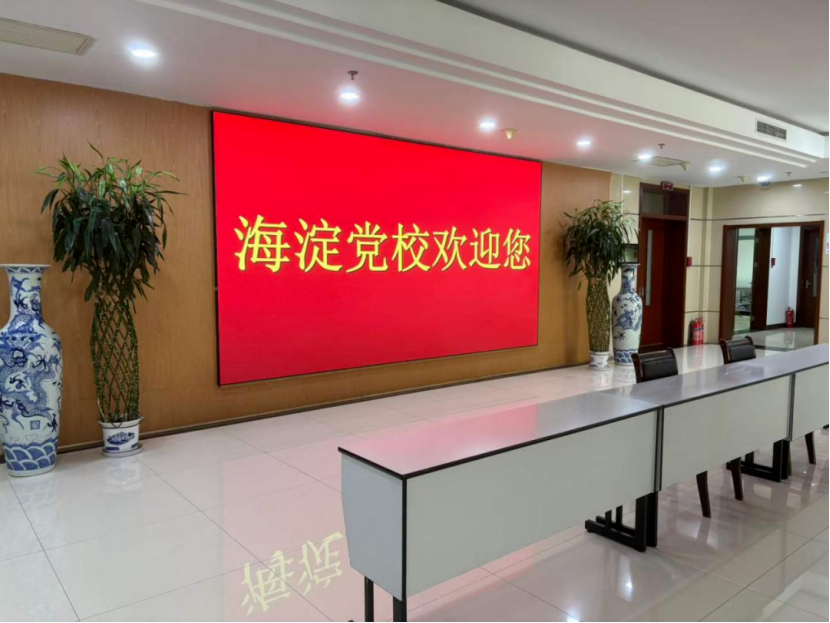
On 24 April 2026, the 2026 Haidian District Training Programme “Fulfill the Dual-Carbon Mission and Safeguard Green Development”, co-sponsored by the Organization Department of the CPC Haidian District Committee, Haidian District Bureau of Ecology and Environment and Haidian District Development and Reform Commission, successfully concluded at the Party School of CPC Haidian District Committee.
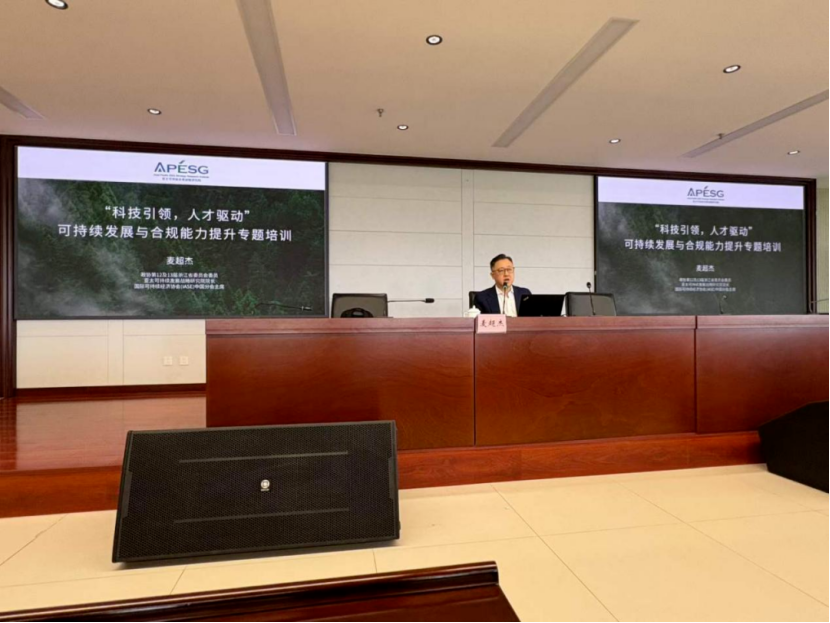
Mr. Joseph Mak, Dean of Asia-Pacific ESG Strategy Research Institute (APESG) and Chairman of International Association for Sustainable Economy (IASE®) China Chapter, was invited to deliver a special lecture on corporate Environmental, Social and Governance (ESG) and sustainable development, sharing systematic and practical professional insights with leading cadres and persons-in-charge from all district departments and sub-district/town authorities.
Special Lecture: Align with the 15th Five-Year Plan, Empower Green High-quality Development of Haidian via ESG
Under the theme “Technology-led, Talent-driven – Boosting Sustainable Development and Compliance Capacity”, Dean Joseph Mak integrated green development targets of the national 15th Five-Year Plan, carbon peaking implementation plans of Beijing Municipality and Haidian District, as well as global and domestic ESG regulatory trends and policies. He systematically interpreted the contemporary connotation, policy evolution and practical value of ESG, and thoroughly analyzed opportunities and challenges for Haidian’s high-quality development empowered by ESG.
He pointed out that amid the growth of new quality productive forces and global sustainable development trends, ESG is no longer merely a compliance obligation for enterprises, but a core competitive edge supporting green tech innovation, industrial upgrading, global expansion and regional high-quality growth. Faced with EU international compliance rules including CSRD (Corporate Sustainability Reporting Directive), CSDDD (Corporate Sustainability Due Diligence Directive) and CBAM (Carbon Border Adjustment Mechanism), alongside domestic sustainable disclosure standards and ESG supervision requirements for central SOEs and listed firms, both governments and enterprises must rapidly build systematic awareness and implementation capabilities.
Joseph Mak stated that as the core zone of Beijing’s international center for technology and innovation and a hub for high-tech enterprises and listed companies, Haidian District should fully embed ESG concepts into the whole process of regional governance, industrial services and enterprise incubation. ESG will fuel green transition, boost enterprises’ cross-border compliance competitiveness and build an international green talent system, delivering robust support for developing world-class tech parks and a Beautiful Haidian. Drawing on Haidian’s unique developmental endowments, he put forward targeted proposals: take standard-setting as a guide to develop industry-specific ESG codes for the tech sector based on local innovation strengths; improve the ESG talent cultivation system to consolidate the talent foundation for regional green development via professional training; leverage digital tools to empower corporate ESG governance and boost management efficiency and transparency; and build a responsible business environment from the perspective of social governance.
Notably, the central government issued a landmark signal on dual-carbon assessment during the training programme. On 23 April 2026, the General Office of the CPC Central Committee and the General Office of the State Council officially issued the Comprehensive Evaluation and Assessment Measures for Carbon Peaking and Carbon Neutrality. The document stipulates that special dual-carbon assessments will be carried out on Party committees and governments of all provinces, autonomous regions and municipalities directly under the Central Government starting from 2026, with total carbon emission control and carbon emission intensity reduction set as core assessment indicators. Assessment results will be directly incorporated into the performance evaluation system for local Party and government leading groups and cadres. This measure further underscores the significance of ecological protection, carbon emission control and ESG governance, imposing rigid requirements on local authorities to advance green low-carbon transition.
Moving forward, APESG will give full play to its professional strengths based on cutting-edge ESG research, deepen exchanges and cooperation with local governments, industrial partners and research institutions, and continuously advance the implementation of ESG concepts and long-term capacity building. It will support regional green low-carbon transition and high-quality development, contributing professional expertise to deliver the green development arrangements of the national 15th Five-Year Plan and steadily achieve the dual-carbon goals.